
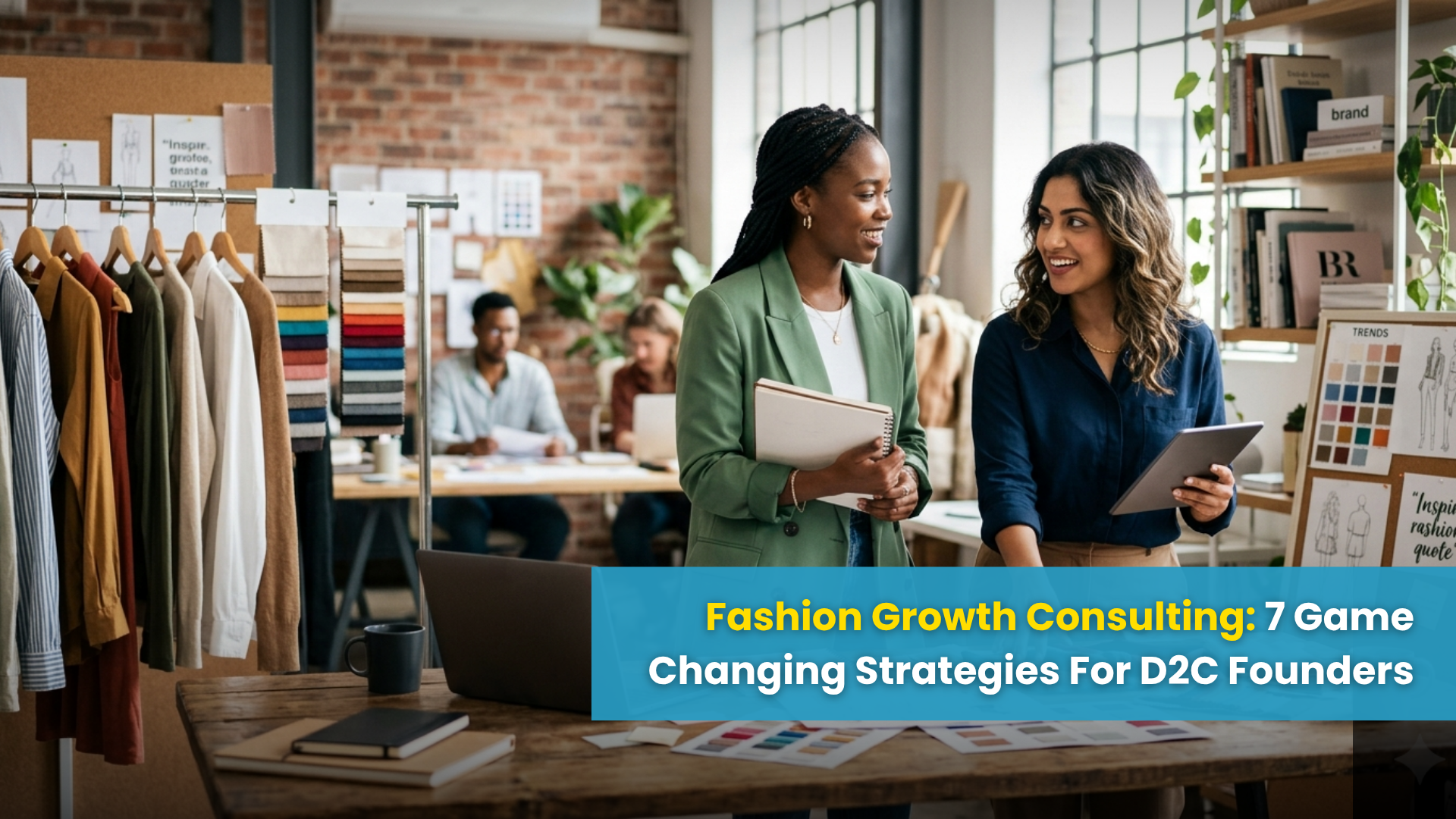
Running a D2C fashion brand can feel exciting and exhausting at the same time, because on some days it looks like everything is moving. You are posting content, testing creatives, speaking to vendors, planning collections, running ads, checking website numbers, and trying to stay visible. But underneath all that activity, growth can still feel strangely unstable.
That is usually the moment when founders start looking for real fashion growth consulting.
Not because they need more generic advice, and not because they want another motivational framework, but because they want clarity on what is actually holding the brand back. Is the problem weak positioning? Is it poor conversion? Is it that traffic is coming but trust is not building? Is retention getting ignored? Or is the brand simply doing too many disconnected things without a clear growth system behind them?
That distinction matters a lot, because fashion growth rarely breaks in one obvious place. It usually leaks across the whole system.
Short Answer: What Does Fashion Growth Consulting Actually Help With?
Good fashion growth consulting helps founders identify where growth is breaking first, what should be fixed before anything else, and how traffic, conversion, retention, authority, and profitability should work together.
It is not just about getting more sales quickly. It is about building a fashion business that grows with more control, cleaner decision-making, and stronger long-term momentum.
Why Fashion D2C Growth Gets Messy So Fast
Fashion is not a simple ecommerce category, and that is exactly why so many brands struggle even when they have decent products.
In a lot of other categories, a functional product and a decent ad account can create some predictable movement. Fashion does not work that cleanly. Here, perception matters more. Trust matters more. Creative quality matters more. Product-market fit is often more emotional. Repeat purchase behaves differently. And even when people like the brand, they may still delay buying if the message, the offer, or the website experience does not feel strong enough.
That is why D2C fashion growth starts getting messy so quickly. A founder may think the problem is traffic, but the real issue is conversion. Another founder may think ads are underperforming, but the actual problem is weak positioning. Someone else may blame low repeat sales on the market, when the real issue is that retention was never designed properly in the first place.
This is also why effort and progress are not the same thing.
You can be busy every day and still move slowly if the business is growing through reaction instead of through systems.
What Makes Fashion Growth Consulting Different From Generic Business Advice
A lot of business advice sounds smart because it is broad enough to apply anywhere. But that is also the problem. Broad advice does not always help a fashion founder decide what to fix first.
Good fashion consulting is more specific than that. It understands that fashion brands do not just grow through ads, or content, or influencer collaborations, or better website design in isolation. They grow when the right things start supporting each other.
That means:
- positioning has to make customer acquisition easier
- content has to build brand authority, not just fill social feeds
- conversion has to improve before traffic scaling becomes expensive
- retention has to support profitability
- founder decisions have to become cleaner as the business grows
At PreCrux, this is exactly how we think about growth. We do not start by asking what sounds trendy. We start by looking at where the brand is leaking momentum, what is creating friction, and which move will unlock the highest-leverage change first.
That is what separates real growth consulting for fashion brands from generic advice that sounds good but changes very little.
2. Build A Content System, Not Just Content Volume
A lot of fashion founders assume content means posting consistently. But consistency alone does not build trust.
You can post every day and still fail to create authority if the content is repetitive, disconnected, or too focused on surface-level aesthetics. Fashion content has to do more than just look polished. It has to help the customer understand the brand, trust the brand, remember the brand, and eventually choose the brand.
That is where a content system becomes more valuable than content volume.
A stronger content engine for a fashion brand usually includes a healthy mix of:
- founder perspective
- product storytelling
- style education
- customer proof
- category explanation
- trust-building content
- collection and intent-based search demand capture
This matters because fashion brand authority is not built by looking active. It is built by looking credible, relevant, and worth returning to.
At PreCrux, this is where our Authority Builder thinking becomes important. We do not look at content as a social media task. We look at it as an authority system that reduces friction across the funnel. Better content makes discovery easier, trust stronger, and conversion less dependent on constant paid pressure.
3. Improve Conversion Before You Chase More Traffic
This is where a lot of D2C founders lose money without realizing it.
When revenue feels slow, the instinct is often to push harder on traffic. More ads. More influencer campaigns. More collaborations. More acquisition experiments. But if the website is leaking conversion, then more traffic simply means more people entering a weak system.
That is not scale. That is amplified inefficiency.
In fashion, conversion usually breaks first in places like:
- homepage clarity
- collection page organization
- PDP trust gaps
- offer communication
- sizing hesitation
- social proof visibility
- checkout friction
And what makes this more serious is that weak conversion pushes up the perceived pressure on paid acquisition. The founder then thinks the market is expensive, when sometimes the business is just under-converting.
This is one reason fashion funnels matter more than people think. A strong funnel is not just about getting traffic to a page. It is about making sure the visitor understands the brand, trusts the product, and feels fewer reasons to delay action.
Inside our Traction Accelerator work, this is often one of the fastest areas to unlock better movement. Not because conversion work is glamorous, but because it makes every other growth effort more efficient.
4. Stop Treating Paid Growth As A Standalone Channel
Paid growth can absolutely help a fashion brand move faster. But when founders treat ads like an isolated growth engine, things start breaking.
Ads do not work independently from the business around them. They are shaped by the offer, the creative, the product page, the timing, the trust signals, the audience quality, and the post-click experience. So when performance weakens, it is not always because the media buying is poor. Sometimes the whole system behind the ads is not ready.
This is one reason fashion performance marketing gets misread so often.
A founder may see poor results and assume the ad account needs more optimization, while the real issue is that the landing page does not convert, the offer does not feel compelling, or the brand message is too vague. Another founder may see acceptable ROAS for a while but fail to notice that profitability is under pressure because the retention side of the business is weak.
Paid acquisition works better when it sits inside a stronger operating system.
That means:
- The offer makes sense
- the brand has clarity
- the website removes hesitation
- and the founder understands what success should actually look like beyond surface metrics
5. Retention Is Not A Nice-To-Have In Fashion, It Is The Margin Saver
This is where a lot of fashion businesses quietly suffer.
Founders often overfocus on customer acquisition because acquisition is visible. It feels active. It feels measurable. It feels urgent. But retention is what changes the economics of the business over time.
If customers buy once and disappear, the brand stays under constant pressure to keep paying for fresh demand. If customers return, engage, and build familiarity with the brand, then growth becomes healthier and more resilient.
This does not mean every fashion brand will have the same repeat purchase pattern. Categories differ. Price points differ. buying cycles differ. But customer retention for fashion brands still matters because it affects margin, cash flow quality, and long-term stability.
Early retention systems do not need to be overcomplicated. They simply need to exist.
That may include:
post-purchase flows, smart reorder logic where relevant, audience segmentation, repeat-customer communication, loyalty touches, and better follow-up storytelling.
At PreCrux, this is one of the reasons we think beyond first-purchase wins. Revenue systems become much stronger when retention is treated as part of the growth model, not as an afterthought.
6. Build Brand Authority Before You Need It Desperately
A lot of founders only start caring about authority when performance becomes unstable.
That is usually too late.
Brands that look known, trusted, and clearly positioned do not just enjoy vanity benefits. They often convert better, get better response to campaigns, reduce customer hesitation, and create more resilience when the market gets noisy.
That is why fashion brand authority is not decorative. It is commercial.
Authority can be built through many things working together:
- clear positioning
- thoughtful content
- founder visibility
- consistent creative language
- proof and case-backed trust
- stronger search presence
- customer validation
- clear differentiation
And no, this is not the same as simply posting on social media more often. Social activity without authority architecture often creates visibility without memory.
For founders asking how to strengthen fashion business growth without depending only on paid spikes, authority is one of the most underrated answers.
7. Diagnose The Growth Bottleneck Before Adding More Work
This is probably the most important strategy in the entire article.
Most brands do not need more tactics first. They need better diagnosis.
When growth feels weak, the instinct is often to add more. More campaigns. More platforms. More creatives. More offers. More agencies. More tasks. But if the core bottleneck is still misunderstood, then extra effort only creates extra noise.
This is where a good fashion growth consultant becomes useful.
Because often, what looks like one problem is actually another.
A traffic problem may really be a conversion problem.
A conversion problem may really be a positioning problem.
A retention problem may really be a product expectation problem.
A paid performance problem may really be an offer and landing-page problem.
That is why we at PreCrux think diagnosis has to come before expansion. We would rather help a founder understand what is actually blocking progress than encourage ten more experiments that make the system harder to read.
And honestly, this is where a lot of founders start feeling relief too. Because once the bottleneck is named correctly, growth becomes far less chaotic.
The Growth Leak Snapshot: What Usually Breaks First At Each Stage Of A Fashion D2C Brand
| Stage | What Usually Looks Fine | What Usually Breaks First | What Needs Fixing First |
|---|---|---|---|
| Early Launch | product, visuals, excitement | positioning and customer clarity | message-market fit |
| Early Traction | traffic, engagement, interest | conversion and offer alignment | funnel improvement |
| Growth Stage | revenue movement, acquisition activity | retention and CAC control | lifecycle and profitability systems |
| Plateau Stage | content volume, operational activity | attribution, authority, and efficiency | execution sequencing |
This is where the conversation gets more practical.
When founders work with us at PreCrux, this is often where the real diagnosis begins. Not with a generic question like “how do we grow faster,” but with a much sharper one, which is “what is actually breaking first at our current stage?”
That single shift usually changes the quality of every next decision.
What Most D2C Founders Get Wrong About Fashion Growth
A lot of mistakes in fashion growth are not dramatic. They are subtle. They look reasonable at the moment, and that is why they are dangerous.
One common mistake is confusing activity with traction. A founder sees content going out, campaigns running, and the team looking busy, so it feels like the brand is progressing. But visible activity can still hide strategic weakness.
Another common mistake is overinvesting in acquisition before conversion is ready. The founder wants growth quickly, so money gets pushed into traffic while the website, positioning, and offer still need work.
Then there is the mistake of treating retention too late. Or ignoring authority because it feels slower than ads. Or scaling chaos before systems are stable enough to handle it.
These are exactly the moments where fashion startup consulting becomes useful. Not because founders are incapable, but because outside pattern recognition can often see what internal pressure hides.
How We At PreCrux Think About Fashion Growth
At PreCrux, we think about growth as a sequence, not as a pile of tactics.
That means we want to understand where the brand is, what kind of pressure it is under, what stage it is actually in, and which lever is most likely to change the trajectory fastest. For one brand, that may be positioning. For another, it may be conversion. For another, it may be authority-building or revenue systems.
That is why our services map naturally to different stages of growth.
Our Traction Accelerator approach makes sense when the brand has movement but not enough structure.
Our Authority Builder thinking matters when the brand needs stronger trust and discovery systems.
Our Revenue Engine lens becomes important when the business needs healthier compounding, not just more activity.
And our Modular Growth Systems approach works well when the founder has a specific bottleneck and wants focused improvement without unnecessary complexity.
These are exactly the moments where fashion startup consulting becomes useful.
We are best suited for founder-led brands that are serious, growth-aware, and ready to fix the system, not just decorate the surface.
What To Do Next If Your Fashion Brand Feels Stuck
If the issue is clarity, do not rush to add channels.
If the issue is conversion, do not assume more traffic will solve it.
If the issue is retention, do not treat it like a later-stage luxury.
And if the issue is not obvious, do not keep guessing for months.
That is exactly the stage where a founder benefits from clearer diagnosis.
If your brand is growing, but not cleanly, a Free Growth Diagnostic with PreCrux is the simplest next step. It helps you understand whether the next move should be around positioning, conversion, retention, authority, or broader execution support.
Not every brand needs the same answer. But almost every founder benefits from finding the real one faster.
Final Thoughts
Fashion growth gets romanticized too often.
People talk about visibility, trends, creatives, campaigns, and momentum, and yes, all of those things matter. But behind every brand that grows well, there is usually something much less glamorous holding it together, which is better sequencing, better diagnosis, and better execution.
That is why fashion growth consulting matters.
Not because founders need someone to tell them to work harder, but because they need clearer judgment around what actually deserves their attention first. Once that happens, growth starts feeling less random. The business becomes easier to read. And the next step stops feeling like a gamble every time.
For D2C founders, that shift can change everything.
Frequently Asked Questions
1. What Is Fashion Growth Consulting?
Fashion growth consulting helps fashion brands identify what is blocking growth, prioritize the right fixes, and build stronger systems across positioning, acquisition, conversion, retention, and authority.
2. How Is Fashion Growth Consulting Different From General Business Consulting?
General business consulting can stay broad. Fashion growth consulting is more specific to the way fashion brands actually scale, including customer perception, product storytelling, conversion behavior, repeat purchase, and channel interplay.
3. What Usually Slows D2C Fashion Growth First?
It depends on the stage, but common early bottlenecks include weak positioning, poor conversion, scattered content, rising CAC, weak retention, and a lack of clear execution sequencing.
4. How Do You Scale A D2C Fashion Brand In India Without Wasting Budget?
Usually by fixing clarity before forcing scale. That means improving positioning, conversion, offer strength, retention systems, and channel sequencing before increasing acquisition spend aggressively.
5. Why Is Retention So Important In Fashion Business Growth?
Because retention helps protect margins, improves revenue quality, and reduces pressure on constantly buying fresh customers through paid channels.
6. Do Fashion Brands Need Consulting, Or Just Better Marketing Execution?
Some need better execution. Some need stronger diagnosis before execution. The real answer depends on whether the bottleneck is already known or still being misunderstood.
7. When Should A Founder Hire A Fashion Growth Consultant?
Usually when the brand has some movement, but growth feels inconsistent, expensive, or hard to read. That is often the point where outside diagnosis becomes much more valuable than more random experimentation.