
A lot of ecommerce brands do not actually have a traffic problem. What they have is a structure problem, and because of that, the traffic they do get never turns into the kind of steady, compounding growth they were hoping for. From the outside, it can look like things are moving, because there are impressions, there are rankings, and there is activity, but underneath that, the system still feels messy, disconnected, and harder to scale than it should be.
That was the kind of situation we stepped into here. Due to client confidentiality, we are referring to this business simply as a leading US-based golf DTC brand. What we can share, though, is the result: 80K+ organic clicks and 3M+ impressions, backed by Google Search Console data, and more importantly, a much stronger organic engine than the one the brand started with.
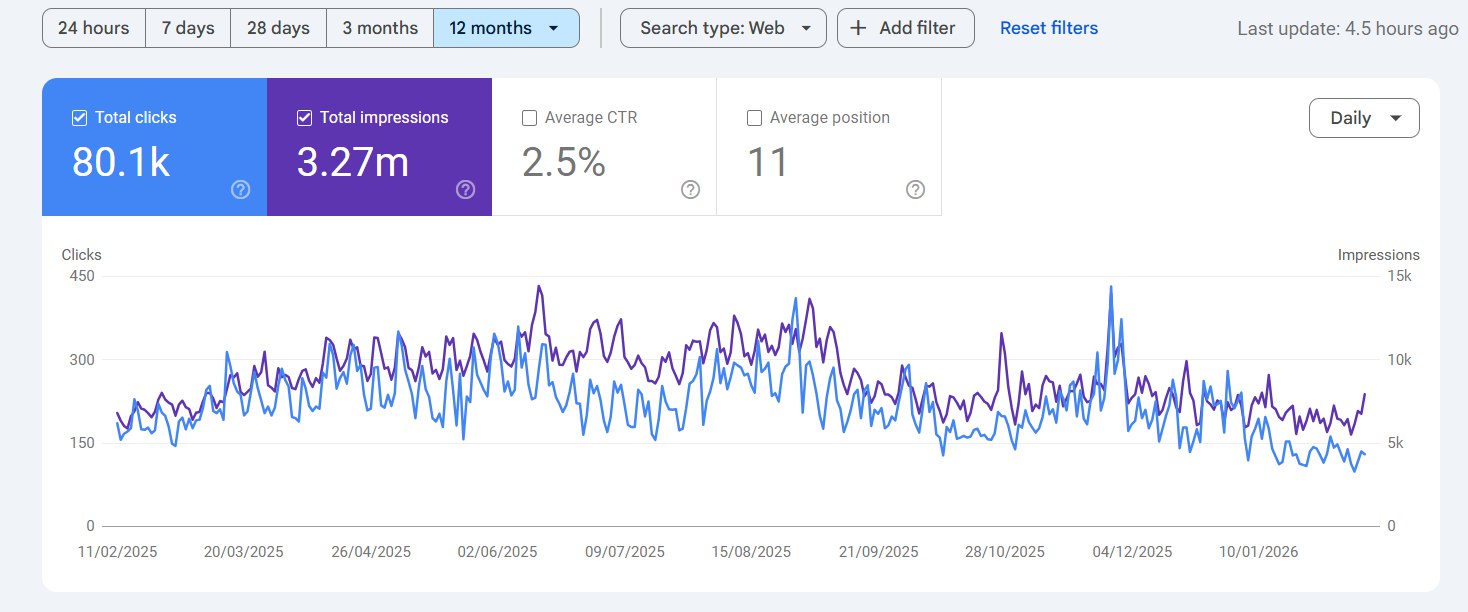
Google Search Console snapshot from this project, shared to illustrate the growth trajectory while keeping the brand confidential.
Those numbers matter, yes, but the bigger story is not that traffic went up. The bigger story is that what looked like active organic performance at first was not actually a clean, scalable system, and once we fixed that, the growth started making much more sense.
Why “Messy Traffic” Is a Bigger Problem Than Most Brands Realize
This is one of those issues that founders often feel before they can clearly explain it.
They look at their dashboards and they see that the site is getting visits. Some pages rank. A few terms perform well. Search Console is not dead. So naturally, the assumption becomes that organic is working, or at least half-working, and maybe it just needs more time or more content.
But messy traffic usually means something deeper is off.
It often means visibility exists, but it is not being directed properly. It can mean the right pages are not getting enough support, or the wrong pages are getting attention without helping the business commercially. Sometimes it means content exists, but it is not reinforcing the parts of the site that should actually be driving authority and discovery. And sometimes it means impressions are growing, but the structure underneath that growth is too weak for it to compound properly.
That was the broader lens we brought into this project.
At PreCrux, we do not look at organic growth as a simple question of “are there visitors or not?” We look at whether the traffic pattern actually reflects a system that can scale. Because traffic can exist without momentum, and visibility can exist without real strategic strength. So from the beginning, our goal at PreCrux was not just, let us get this brand more visibility. The real goal was, let us help this brand own a meaningful search position in a niche where search perception could influence authority, trust, and inbound interest all at once.
What We Saw Before We Started
When we evaluated this brand, the opportunity was obvious, but so was the inconsistency.
This was not a zero-visibility situation where everything had to be built from scratch. The site already had signals. There was existing search activity, there was some discoverability, and there was enough movement to show that the brand absolutely had room to grow organically. But the performance did not yet feel like it was being held together by a deliberate growth system.
The organic picture looked active, but not yet clean.
There were three broad issues we were paying attention to from the start.
First, the traffic pattern did not feel strategically tight enough. Some visibility existed, but it was not compounding the way a strong ecommerce SEO system should. That usually tells you that the foundation is producing movement, but not enough coordinated momentum.
Second, the pages that should have mattered most commercially were not benefiting enough from the broader support structure around them. This is where many DTC brands quietly lose growth. They have pages with real potential, but the supporting content, internal linking, and intent alignment are not strong enough to help those pages become category anchors.
Third, the business had more organic upside than the current performance suggested. That is often the most exciting kind of project, because it means the problem is not a dead market or a weak category. It means the system is underperforming relative to the opportunity.
So from the beginning, our thinking at PreCrux was simple: this brand does not need random SEO activity. It needs a cleaner organic direction.
What Success Needed to Mean Here
We were not trying to create a nice-looking graph and call it a day.
For this project, success needed to mean that the site became more structurally capable of generating and sustaining organic growth. The clicks and impressions were important, but only because they would reflect something healthier underneath.
That meant success had to include:
- stronger visibility across meaningful search opportunities
- better support for the pages that mattered most
- improved alignment between content, search intent, and page hierarchy
- a more coherent internal growth system rather than scattered wins
- organic movement that felt more scalable, not just more active
This distinction matters a lot.
More traffic alone can hide problems for a while. A healthier organic engine solves them.
Our Growth Execution Plan
We approached this the same way we approach most serious growth work at PreCrux: by reducing noise, prioritizing what has leverage, and making sure the execution layers are helping each other instead of pulling in different directions.
Phase 1: Cleaning Up the Organic Picture
Before you improve anything, you need to understand what is actually happening.
So the first phase was about getting clarity. Where was the site already showing up? Which pages had potential but were under-supported? Which visibility patterns looked promising, and which ones looked more accidental than scalable? Where was the site getting movement, but not enough compounding value from that movement?
That clarity matters because otherwise teams end up reacting to symptoms. They publish more, tweak random pages, or chase more keywords without understanding why growth is not sticking properly.
Phase 2: Strengthening the Pages That Mattered Most
Once the picture became clearer, the next step was making sure the right pages were positioned to benefit.
This is where ecommerce SEO becomes more than just rankings. It becomes about page importance, intent alignment, and commercial relevance. The pages that matter most to the business need stronger support, stronger clarity, and stronger search fit. If those pages stay underpowered, then even increasing traffic elsewhere can leave the actual business impact feeling underwhelming.
So the work was not just about creating more entry points. It was also about making the core pages more deserving of the attention they were capable of attracting.
Phase 3: Building a Better Content and Internal Linking System
This is where many brands think they are doing content strategy when in reality they are just producing content.
A real content system does not exist to make a blog section look active. It exists to reinforce important pages, strengthen topical depth, improve discoverability, and help authority flow more deliberately across the site.
That is why internal linking mattered here as much as content creation itself. Content without structure can create noise. Content with proper relationships can create momentum.
So instead of treating pages and blogs like isolated assets, we treated them as parts of one organic system.
Phase 4: Turning Organic Activity Into Organic Momentum
Once the right pieces started aligning, the site was no longer just collecting visibility. It was starting to build organic momentum.
That is the shift most founders should care about. Because a brand can get traffic for months and still feel confused about whether organic is truly scaling. But when the system becomes cleaner, you start seeing a different kind of confidence in the performance. The growth becomes easier to interpret, easier to support, and easier to build on.
Phase 5: Refining What Was Working
We did not treat movement as the finish line.
As traction strengthened, the focus shifted toward refinement. What was gaining momentum needed reinforcement. What was helping the site compound needed more support. And what looked like distracting activity needed to stay secondary.
That kind of restraint matters. A lot of growth systems get messy again because teams start chasing too many directions the moment they see some success. We prefer consolidation before expansion.
What “Messy Traffic” Actually Looked Like - And Why More Visitors Alone Would Not Have Solved It
This is probably the most important part of the story.
When we say the traffic was messy, we do not mean the site had bad traffic in some dramatic sense. We mean the traffic pattern did not yet reflect a clean, intentional, scalable organic system.
In practice, messy traffic can look like this:
- visibility exists, but it is uneven across the site
- some pages get movement, but not enough support to turn that into stronger authority
- traffic activity is present, but the commercial logic underneath it is weak
- content exists, but it is not reinforcing the most important parts of the site properly
- growth feels real, but not yet reliable
And that is exactly why simply getting more visitors would not have been enough.
If we had just pushed harder on traffic volume without cleaning the underlying structure, the brand may have seen bigger numbers for a while, but the system would still have remained fragile. More visits alone do not fix weak page prioritization. They do not solve poor support relationships. They do not automatically create compounding growth.
What we wanted instead was not just more traffic. We wanted better traffic behavior within a stronger organic framework.
That is a completely different goal, and it leads to much smarter decisions.
What Actually Moved the Needle
There was no one magic trick here, and honestly, that is how most real growth work looks.
The gains came from a combination of sharper direction and better sequencing. A few things mattered more than anything else:
- Better page prioritization
Not every page deserves equal effort, and not every page contributes equally to growth. The moment you get clearer on which pages matter most, the rest of the system becomes easier to organize around them.
- Stronger keyword-to-page alignment
One of the biggest reasons DTC SEO gets diluted is because too many pages are loosely competing for similar intent, or because the site is ranking without enough clarity around who should own what. Cleaner ownership almost always improves momentum.
- Support content that reinforced growth
This was not about publishing for the sake of output. It was about building supporting relevance so the core parts of the site could perform better.
- Internal linking with strategy behind it
Internal linking is often treated like a technical checkbox, but in reality, it is one of the clearest ways to help search engines and users understand page relationships. When done intentionally, it helps the entire system behave better.
- Doing the right things in the right order
This part matters more than most people realize. A site can have all the right ingredients available, but if the sequence is wrong, growth still feels slow. Order creates leverage.
The Results We Saw
The headline result was clear in Search Console: 80K+ organic clicks and 3M+ impressions.
But the reason those numbers matter is not just because they look impressive on a screenshot. They matter because they signaled that the site’s organic engine was becoming healthier, stronger, and much more capable of compounding.
The Search Console data made one thing very clear: this was not just a case of small ranking lifts here and there. The brand was moving into a different level of visibility.
And that is what we care about most.
Because bigger numbers without better structure can disappear as quickly as they arrive. But bigger numbers coming from a stronger system usually point to something more durable. They suggest that the site is not just getting discovered more, but is doing so through a cleaner, more scalable organic model.
What Founders Can Learn From This
There are a few lessons here that go well beyond golf, and honestly, they apply to a lot of DTC brands.
First, not all traffic is healthy traffic. A brand can have rankings, visits, and impressions and still be operating with an organic structure that is too loose to scale properly.
This is one of the biggest lessons from the project. Fast movement usually does not come from doing more. It comes from doing the right things in the right order.
Second, more content is not automatically the answer. More content only helps when it strengthens the pages, categories, and search paths that matter most to the business.
Third, compounding growth usually starts when the system becomes cleaner. Not just busier. Cleaner.
And fourth, founders should stop asking only, “How do we get more traffic?” A much better question is, “Is our current traffic pattern actually supported by a strong enough system to scale or not?”
That one shift in thinking changes a lot.
Why This Matters to the Way We Work at PreCrux
This project reflects how we think.
We at PreCrux do not treat SEO as a publishing routine or a list of disconnected tasks. We look at whether the business has a real growth system underneath the activity. When we work with brands, we are not only trying to create movement. We are trying to create clarity, support, and momentum in the places that matter most.
That is why this kind of case study matters to us.
It shows that growth does not always require starting from zero. Sometimes the opportunity is already there, but the structure is too messy for that opportunity to fully show up. Once the system is cleaned up and aligned properly, the business can start performing closer to its real potential.
That is a much more useful way to think about growth execution than simply asking for more traffic every month.
Final Thoughts
This was not just a story about 80K+ clicks and 3M+ impressions.
It was a story about what happens when a brand moves from fragmented organic activity to a much more coordinated growth system. The numbers were important, yes, but what mattered more was the quality of the engine behind them.
A lot of ecommerce businesses are closer to meaningful organic growth than they think. The problem is just that their traffic is sitting inside a system that is too messy, too under-supported, or too disconnected to compound properly.
When that gets fixed, growth starts feeling different. It starts feeling more interpretable, more strategic, and much more scalable.
And that is really the core takeaway here.
If your brand is already getting traffic, but the organic side still feels inconsistent, harder to scale, or less commercially useful than it should be, then the issue may not be effort. It may be that the structure underneath the traffic is still not doing enough of the heavy lifting.
That is exactly the kind of gap we help diagnose at PreCrux.