

MOVER

45K+
Clicks
Page 1
Keyword Rankings
Local SEO
Core Lever
90 Days
Timeline
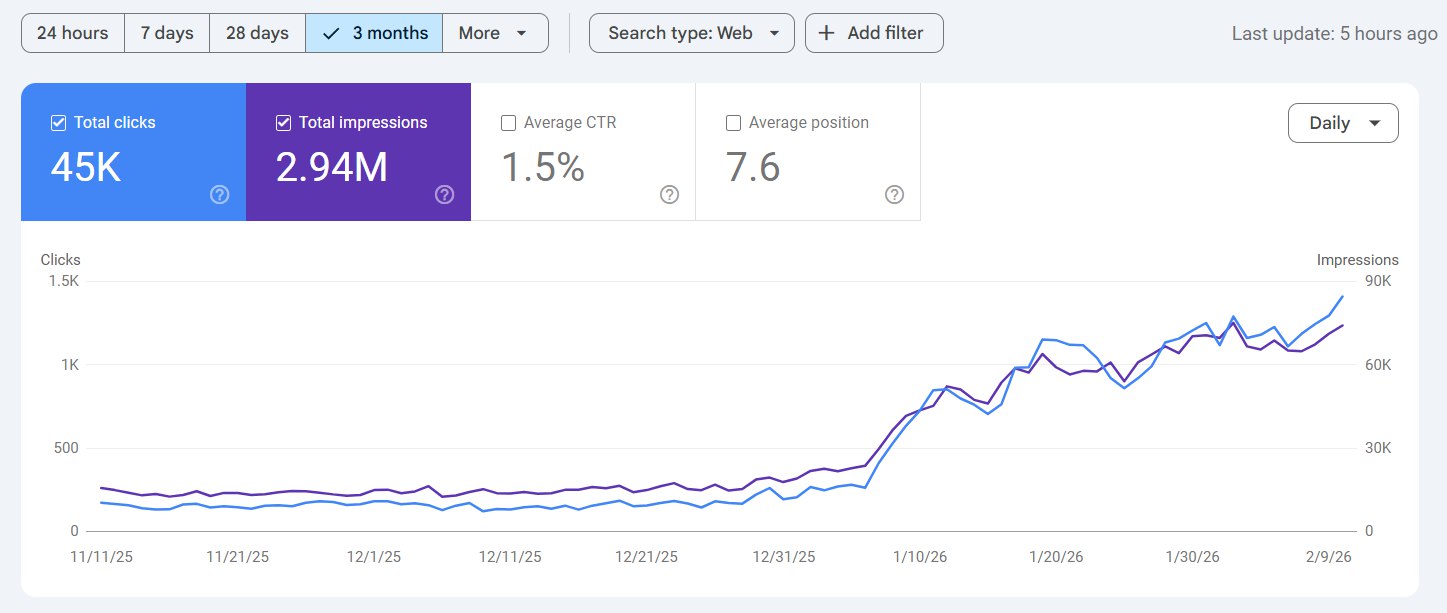
Google Search Console snapshot showing how visibility moved slowly at first, then accelerated sharply once the right local SEO and content system started compounding.
Overview
A lot of local service brands do not lose online because demand is missing. They lose because their search presence never becomes strong enough to convert that demand into real momentum.
That was the bigger story here.
When we started working on Mover, the business already had market relevance. People were searching. The category had demand. The opportunity to grow through search was there. But the site was not yet behaving like a serious local growth engine. Visibility existed in fragments, movement was there in patches, but it was not compounding the way it should for a service business that wanted stronger discoverability and more consistent lead flow.
And that is where many brands stay stuck for far too long.
They keep publishing, keep tweaking, keep hoping for a lift, but the overall curve never really bends. It moves, but it does not break out. Then suddenly, when the right system gets put in place, the graph starts telling a completely different story.
That is exactly what happened here.
This was not just about getting Mover more traffic. It was about building the kind of local SEO and content system that could take a slow-moving search presence and turn it into something much more visible, much more trusted, and much harder to ignore.
The Challenge
The challenge was not that Mover had zero visibility. The challenge was that the visibility it had was too weak, too inconsistent, and too under-supported to create serious momentum.
This is a common local growth problem.
A service business may already have pages, already have some search presence, and already be getting discovered here and there. But if the site is not aligned properly around local search intent, service relevance, and supporting content, then the growth stays flat for longer than it should. The business remains visible enough to survive, but not visible enough to dominate.
That was the danger here.
Mover needed more than a few isolated ranking improvements. It needed a stronger local search foundation, clearer reinforcement around service demand, and a structure that could actually push key terms toward page one and keep them there with more consistency.
Because when that structure is missing, even a good business can stay trapped in the slow-growth zone.
What We Found
Once we looked deeper, it became clear that this was not really a “low clicks” problem. It was a compounding problem.
What looked slow on the surface was actually a system waiting for the right structure underneath it.
The business had enough demand potential. The market was there. But the site was not yet extracting enough value from that demand because the local SEO foundation and the content support system were not working together strongly enough. Search visibility was present, but it was not being reinforced properly. Important service-related intent was not yet carrying enough strength. And the site as a whole was not behaving like one connected engine built to keep building on its own momentum.
That is the difference most people miss.
They see a low or moderate traffic curve and assume the answer is more activity. But in cases like this, the answer is often better structure. Better local relevance. Better support around the pages that matter. Better alignment between what people are searching, what the business offers, and how the site helps search engines understand those relationships.
Once we saw that clearly, the next move became obvious. This did not need random SEO. It needed a proper local growth system.
What We Changed
1. We strengthened the local SEO foundation
The first priority was making the site more aligned with the actual local demand it needed to capture.
That meant improving how service relevance and local search intent were being supported, so the business could become easier to discover in the places that mattered most. Local SEO works best when the site stops speaking in vague terms and starts reinforcing exactly where it belongs, what it serves, and why it is relevant in that context.
So before chasing the scale, we made sure the foundation was strong enough to carry it.
2. We built stronger content systems around service visibility
This part mattered a lot.
We did not use content like filler. We used it like support. The goal was not to make the site look active. The goal was to help key pages build more strength, more relevance, and more discoverability over time. That is what turns content from an activity into a system.
When content systems are built properly, they stop behaving like disconnected posts and start working like reinforcement around the visibility the business actually needs. That is what helped Mover move from slow growth toward stronger page-one presence.
3. We improved the site’s ability to compound
This is where things started changing more dramatically.
The real shift came when the local SEO layer and the content support layer stopped functioning like separate tasks and started behaving like one connected growth engine. Once that happened, visibility no longer felt random or fragile. It started building on itself.
And that is exactly what you can see in the screenshot.
For a while, the line moves slowly. Then the right system starts taking effect, and the curve changes character. It begins climbing harder, faster, and with much more confidence. That kind of graph is not usually the result of one lucky ranking jump. It is what happens when the underlying structure finally becomes strong enough to let demand turn into momentum.
The Results
The outcome was clear.
Mover reached 45K+ clicks, 2.94M impressions, and an average position of 7.6 within 90 days, with stronger page-one visibility across the keyword landscape that mattered most.
But what makes this case powerful is not just the total numbers.
It is the shape of the growth itself.
That curve tells a more convincing story than a single metric ever could. In the beginning, growth is present but relatively slow. Then, once the right local SEO and content structure starts compounding, the curve breaks upward and keeps going. That is what real search momentum looks like. It does not just spike once and disappear. It builds.
That is why this was more than a reporting win.
It was a visibility breakthrough. The kind that changes how a business shows up, how often it gets discovered, and how much easier it becomes for the right customers to find it in the first place.
Why It Worked
This worked because we did not treat the problem like a traffic shortage.
We treated it like a local growth system problem.
That difference matters because a lot of SEO work stays too shallow. It focuses on keywords without building a strong enough structure around them. It optimizes pages without giving those pages the support they need. It produces content without making that content strategically useful. And then teams wonder why growth feels slow and unstable.
Here, the breakthrough came from building the right layers in the right order.
Local SEO gave the business stronger relevance where it mattered. Content systems gave the site better support and reinforcement. And once those layers started working together, the site stopped behaving like a slow-moving collection of pages and started behaving like a connected search engine for demand.
That is the kind of growth that lasts longer, compounds better, and feels much more trustworthy when you look at the data.
At PreCrux, that is how we think about search execution. Not as isolated improvements, but as systems that make visibility build on itself.
Final Takeaway
A lot of service businesses assume slow growth means low demand.
Very often, it does not.
Very often, it means the site has not yet reached the point where the right structure starts compounding properly. That was the real opportunity with Mover. Once the local SEO foundation became stronger and the content system started reinforcing the right signals, the business moved from slow search activity into a much more serious growth curve.
That is the bigger lesson here.
The breakthrough did not happen because we chased traffic. It happened because we built the kind of local search system that traffic could finally compound through.
If your business already has demand in the market but search growth still feels slower than it should, that usually means the gap is deeper than traffic alone. It usually means the structure underneath your visibility is not doing enough heavy lifting yet.
That is exactly the kind of problem we help diagnose at PreCrux.
Want to get the same results? Book a meeting with us today.