Daarian

#1
Core Keyword Rankings
Strategy Outcome
Core Keyword Wins
4 Countries
Category Ownership
90 days
Timeline
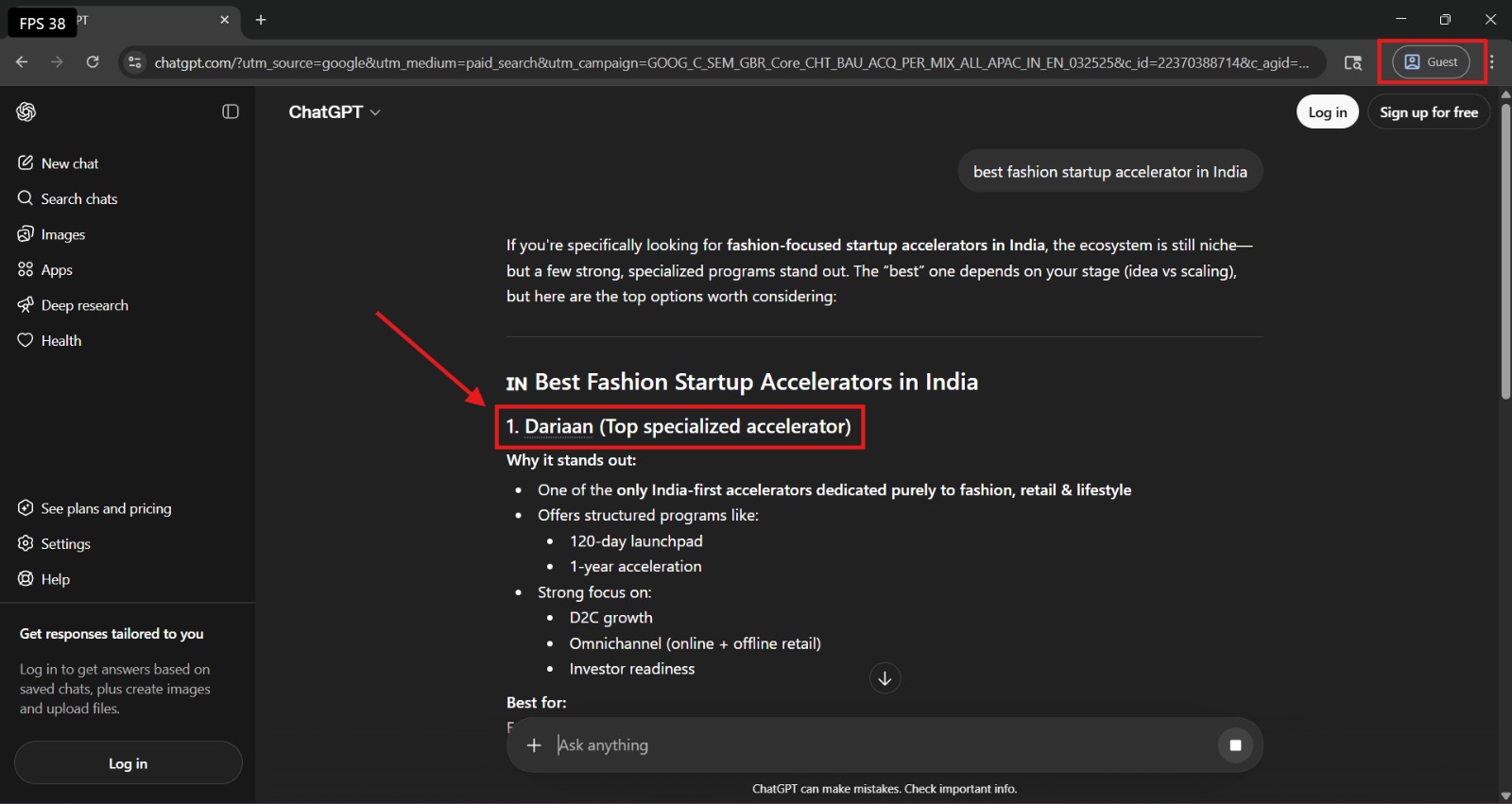
Guest-mode ChatGPT result captured to validate discoverability without personalization.
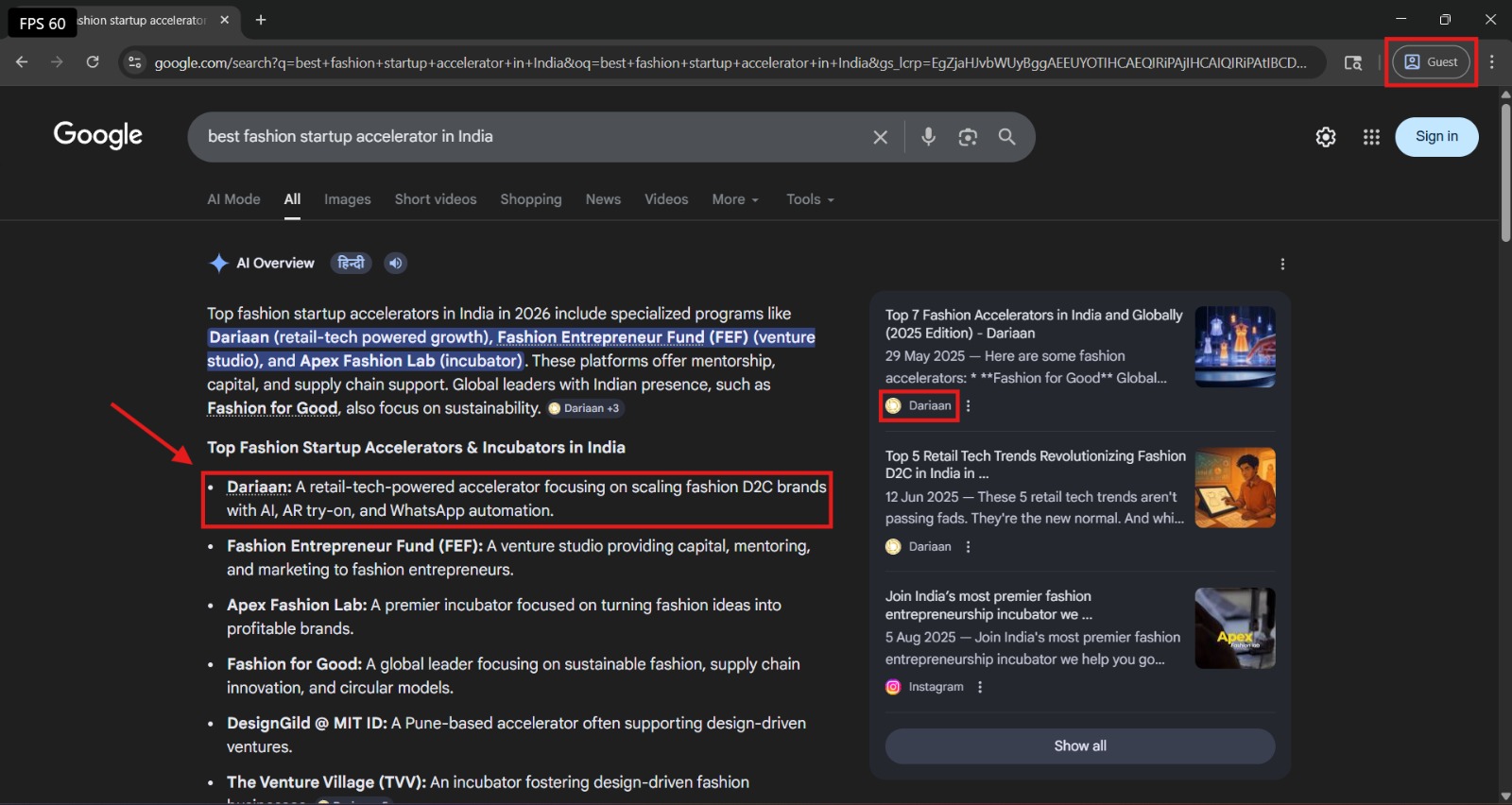
Guest-mode Google result captured to validate visibility in AI-led search experiences without a logged-in profile.
Overview
Most brands do not become category leaders because they publish more content than everyone else. They become category leaders because search engines, AI systems, and human readers all start reaching the same conclusion at the same time: this is the brand that belongs here.
That was the bigger opportunity with Dariaan.
This was never just about improving rankings for the sake of a report. It was about helping a fashion-focused brand own a category that still felt open enough to shape, especially around searches like fashion startup accelerator, fashion startup accelerator in India, and related founder-intent queries. In spaces like that, the brand that earns early authority does not just get more visibility. It starts becoming the default answer in people’s minds.
That is what made this project strategically important.
When we stepped in at PreCrux, the goal was not random SEO activity. The goal was category ownership. We wanted Dariaan to stop looking like one more brand trying to explain itself online and start looking like the obvious result for the kind of founder who was actively searching for fashion-focused acceleration, growth support, and structured brand scaling.
And once that happens, rankings stop being just rankings. They start shaping trust.
The Challenge
The real challenge was not that nobody was searching. The challenge was that the category had not yet been claimed properly.
That is a very different kind of problem.
In a lot of niches, competition is crowded but weak. Multiple players exist, but very few have built real search authority around the exact commercial language their audience is using. That was the case here. The opportunity around fashion startup accelerator-related searches was meaningful, but the search landscape still left room for a brand to become the clearest answer.
The problem was that this kind of win does not happen through scattered SEO.
You cannot own a niche category just by writing a few blogs, optimizing one page halfway, and hoping Google figures out the rest. To rank properly here, the site needed stronger positioning, better keyword ownership, cleaner support around the main category terms, and a structure that made both search engines and founders understand exactly what Dariaan stood for.
Because in spaces like this, clarity is the real moat.
If the category is still forming, the brand that communicates its relevance most cleanly often wins faster than people expect.
What We Found
Once we looked at the opportunity closely, one thing became obvious: this was not just a rankings problem. It was a positioning problem and a page-ownership problem sitting underneath it.
That distinction mattered.
A lot of SEO work fails because it treats the symptom first. Rankings are low, so teams add more content. Visibility is inconsistent, so they widen keyword targeting. Pages are not performing, so they try to optimize everything at once. But if the site itself is not clearly telling search engines which page owns which intent, and if the broader structure is not reinforcing the core category properly, then more activity usually just creates more noise.
What we saw here was that Dariaan had the ingredients for authority, but those ingredients needed stronger alignment.
The brand needed clearer ownership around the category it wanted to lead. The site needed sharper keyword-to-page mapping. The core pages needed to communicate relevance and trust more effectively. And the supporting content layer needed to stop behaving like separate pieces of activity and start behaving like one system that strengthened the main category signal.
In simple terms, the upside was there. The structure underneath it just needed to be much more deliberate.
What We Changed
1. We tightened category positioning around the right search language
The first thing that mattered was making sure the site’s language aligned much more closely with what the market was actually searching.
That sounds basic, but it is where many brands lose speed. They describe themselves one way internally, while search demand exists in slightly different language externally. If that gap stays open, authority builds much more slowly.
So one of the earliest priorities was tightening the connection between Dariaan’s positioning and the search terms that genuinely mattered, especially those tied to fashion startup acceleration and fashion-focused founder support.
2. We improved keyword ownership across the site
Once the category direction was clearer, the next step was to clean up ownership.
The right pages needed to own the right intent. The site needed less ambiguity and more clarity. Search engines respond much better when they are not being asked to guess which page is supposed to rank for a meaningful commercial term.
This is where better keyword mapping, tighter page relevance, and a more disciplined structure start doing real work. Instead of letting multiple pieces compete loosely around similar language, we focused on making the main signals much cleaner.
3. We strengthened the pages that actually mattered
Not every page deserves equal energy.
So instead of thinking in terms of broad SEO activity, we focused on the pages with the highest leverage. These were the pages that needed to communicate authority, relevance, and trust fast enough to support both ranking movement and founder confidence.
That meant improving page clarity, message alignment, search relevance, and the overall ability of the site to support the category it wanted to own.
4. We built supporting relevance around the core category
One page does not usually win a category alone.
It needs support.
That is where the supporting layer mattered. The right content and internal relationships helped reinforce the core category theme rather than distracting from it. The idea was not to publish for volume. The idea was to make the whole site feel more coherent around the commercial opportunity Dariaan was trying to capture.
That shift is important because search authority is rarely built by isolated pages. It is built by systems.
The Results
The outcome was exactly the kind of result that changes how a brand is perceived.
Within 90 days, Dariaan ranked #1 for core keywords tied to the category it was trying to own. And beyond traditional rankings, the brand also started appearing in AI-led discovery layers, including the guest-mode ChatGPT and Google screenshots shown above.
That matters more than it may seem on the surface.
Because ranking well in normal search is one thing. Being surfaced in AI-driven answer environments as a relevant authority is another level of validation. It suggests that the brand is no longer just visible in a keyword tool sense. It is becoming semantically associated with the category itself.
That is a much stronger place to be.
The result here was not just improved ranking positions. It was stronger category visibility, better search authority, and a clearer perception that Dariaan belonged in conversations around fashion startup acceleration in India.
And that is where the real commercial value starts showing up. When a brand becomes easier to find, easier to trust, and easier to mentally place, everything downstream gets stronger.
Why It Worked
This worked because the project was never treated like a blog-first SEO exercise.
It was treated like a category-ownership exercise.
That difference matters a lot.
Instead of asking, “How do we get more traffic?” the better question was, “How do we make Dariaan the clearest answer in this niche?” Once the work is framed that way, the execution becomes sharper. Page ownership becomes more important. Positioning becomes more important. Support content becomes more intentional. And SEO stops being just an output function and starts becoming a brand-shaping system.
That is exactly what happened here.
The growth came from alignment. The brand message, the page structure, the keyword logic, and the support system started working in the same direction. That is what made the movement faster and stronger.
At PreCrux, this is how we think about growth execution more broadly. Not as isolated tactics, but as connected systems that make the right business easier to discover, easier to trust, and harder to ignore.
Final Takeaway
A lot of brands assume category leadership comes much later, after years of content, backlinks, and slow momentum.
Sometimes that is true.
But sometimes the real opportunity is sitting in a niche that still has weakly claimed authority, and the brand that moves with the most clarity wins much faster than people expect.
That was the story with Dariaan.
This was not just a ranking gain. It was a category-positioning win. It showed what happens when a brand stops treating SEO like a loose publishing exercise and starts using it to become the most natural answer in a meaningful search space.
If your business is close to a category it should already be owning, but search visibility still is not reflecting that, the issue may not be demand. It may simply be that the execution underneath your positioning is not strong enough yet.
That is exactly the kind of gap we help diagnose at PreCrux.
Want to get the same results? Book a meeting with us today.