

A Leading US-Based Golf Company

80K+
Organic Clicks
3M+
Impressions
SEO
Growth Engine Rebuilt
12 Months
Timeline
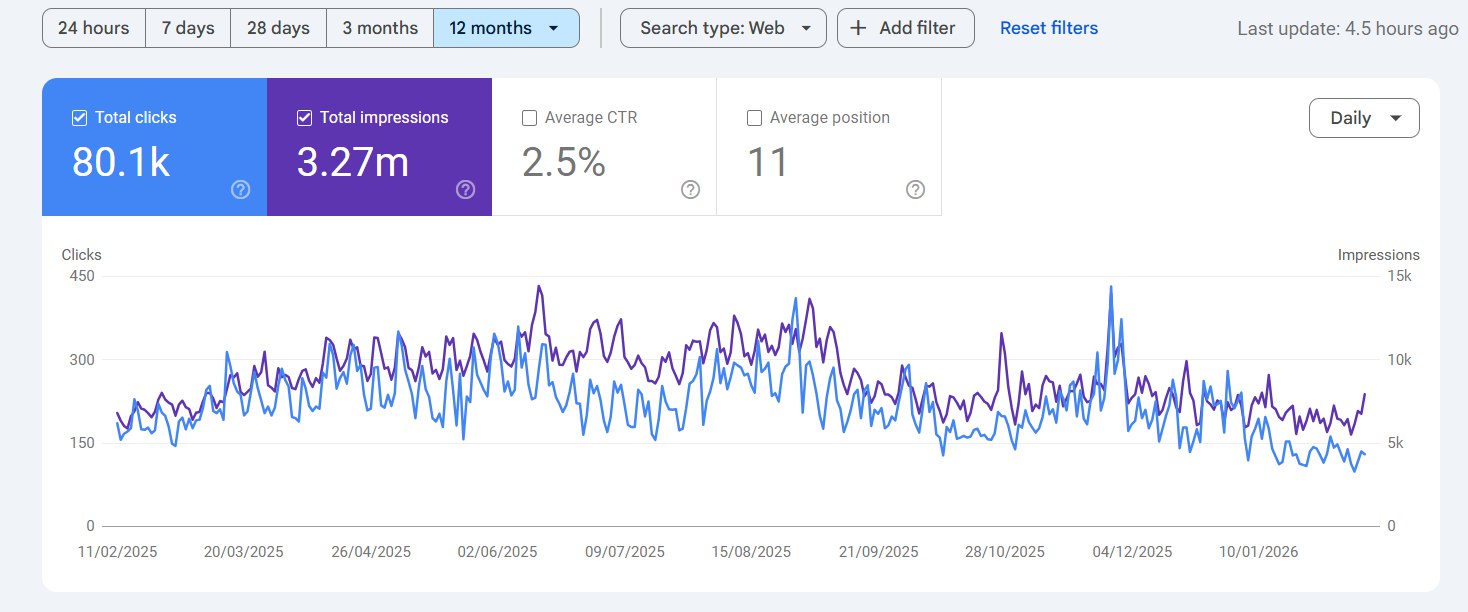
Google Search Console snapshot shared to validate the growth trajectory while keeping the brand confidential.
Overview
A lot of ecommerce brands do not actually have a traffic problem. What they have is a structure problem, and because of that, whatever visibility they do get never turns into the kind of steady, compounding growth they expected.
That was the real story here.
Due to client confidentiality, we are not naming the brand publicly, but this case study is based on our work with a leading US-based golf company. When we started, the business was not invisible. Organic activity already existed, rankings were present in parts of the site, and there was enough movement to suggest real potential. But the growth did not feel clean, and more importantly, it did not feel scalable.
From the outside, that kind of situation can look “fine.” The Search Console is not empty, some pages are performing, and the site has traction. But inside the system, something still feels off. The traffic is there, yet it is not compounding properly. The important pages are not being supported strongly enough. The brand has room to grow, but the organic engine underneath it is not yet built to carry that growth in a structured way.
That is the kind of situation we like stepping into at PreCrux, because this is usually where the biggest upside is hidden. Not in zero-to-one cases where nothing exists, but in businesses where potential is already visible and the real gap is execution quality.
The Challenge
The challenge was not that the brand had no organic momentum at all. The challenge was that the momentum it had was too messy to scale with confidence.
There was visibility, but it did not feel strategically organized. Some pages had movement, but the site as a whole was not behaving like one connected growth system. Important commercial pages were not being supported as strongly as they should have been. Content, search intent, and internal support were not reinforcing each other with enough purpose.
This is where a lot of brands quietly stall.
From a founder’s point of view, the business can feel like it is “doing SEO” because content exists, rankings exist, and traffic exists. But from an operator’s point of view, the more important question is different: does the site actually behave like a scalable organic engine, or is it just collecting scattered wins?
Here, it was much closer to the second.
And that mattered because the opportunity was clearly bigger than the current performance suggested. This was not a niche with no demand. It was not a category where organic growth was unrealistic. The issue was that the growth system was not clean enough yet to convert opportunity into stronger, more consistent momentum.
What We Found
Once we got into the account properly, it became clear that this was not simply a low-traffic problem.
What looked like a traffic issue on the surface was actually a system issue underneath.
The site had organic signals, but those signals were not being supported in the way a serious growth system needs. There was movement, but not enough compounding logic behind that movement. Some visibility existed, but the structure underneath it was not strong enough to help the right pages build authority efficiently over time.
In simple terms, the brand had organic upside, but the site was not extracting enough of it.
This is where many agencies stop too early. They see traffic that is lower than it should be, and they immediately prescribe more blogs, more pages, or more output. But more output is not always the answer. If the organic ecosystem itself is fragmented, then more activity often just creates more noise.
What we saw here was that the site needed stronger alignment across three areas:
- the pages that mattered most commercially
- the content supporting those pages
- the internal structure connecting the whole system
That diagnosis changed everything, because it meant the right move was not to simply “do more SEO.” The right move was to make the site behave like one intentional engine instead of a loose collection of pages competing for attention.
What We Changed
1. We cleaned up the organic picture
The first job was clarity.
We needed to separate what was genuinely working from what was only creating surface-level activity. That meant getting a much clearer read on where visibility was coming from, which pages had real leverage, and where the existing performance was being under-supported.
This part matters more than people think. If you do not understand the current structure properly, you end up reacting to symptoms. You publish more, optimize more, and keep working harder, but the system never becomes much cleaner.
So before trying to scale anything, we tightened the picture first.
2. We strengthened the pages that mattered most
Once the picture became clearer, the next step was making the important pages stronger.
That sounds simple, but this is usually where the difference between average SEO work and serious growth execution starts showing up. Not all pages matter equally. Not all traffic matters equally. And not every ranking opportunity deserves the same level of effort.
So instead of treating the site like one flat list of URLs, we prioritized the pages with the strongest commercial and organic value. We worked on making them more relevant, better supported, and more aligned with the search intent that actually mattered to the business.
That is what started changing the feel of the site. It became less about random visibility and more about building meaningful authority in the right places.
3. We built a cleaner content and internal linking system
Content can either strengthen a site or scatter it.
Here, the opportunity was not to just add more content for the sake of output. It was to create a more useful support system around the pages that already deserved to win. That meant improving how content related to the rest of the site, making internal linking more intentional, and using support pages to reinforce the pages that mattered most rather than leaving them isolated.
This is one of the biggest differences between content activity and content systems.
Content activity makes a site look busy.
Content systems make a site stronger.
And once the right pages, the right support content, and the right internal relationships started working together more deliberately, the brand’s organic growth started feeling much less messy and much more scalable.
The Results
The headline result was clear:
80K+ organic clicks and 3M+ impressions in 6 months.
But the real value of the result was not just the size of the numbers. It was what those numbers signaled.
They showed that the brand’s organic visibility was no longer acting like scattered movement. The site was starting to behave like a real growth engine. Search presence became stronger, the structure underneath the growth became healthier, and the business had a much more scalable base to build from.
That is a more important outcome than most teams realize.
Because big numbers without a stronger system can disappear quickly. Big numbers supported by a healthier organic structure are much more valuable. They suggest that the site is not just gaining more visibility temporarily, but that it is becoming better at earning, supporting, and compounding that visibility over time.
And that is exactly what made this case meaningful. We did not just improve a report. We improved the engine behind it.
Why It Worked
This worked because we did not treat the problem like a simple traffic gap.
More traffic was never the full answer here. A cleaner growth system was.
Once the right pages were prioritized properly, once the support system around them became more intentional, and once content and internal structure started reinforcing each other instead of drifting apart, the business became much easier to scale organically.
That is the part most brands miss.
They think growth slows down because the market is too hard, the niche is too competitive, or SEO just takes forever. Sometimes those things are true. But often the slower, more frustrating reality is that the system underneath the growth is simply too loose to compound well.
That is why execution quality matters so much.
At PreCrux, we do not look at SEO as blog production or isolated ranking work. We look at whether the site is capable of turning existing opportunity into stronger, cleaner, more commercially useful growth. That was the shift here, and that is why the outcome was not just bigger traffic, but better momentum.
Final Takeaway
If your brand is already getting traffic but growth still feels messy, disconnected, or harder to scale than it should be, that usually points to a deeper execution gap.
It often means the issue is not effort. It is structured.
This case study is a good example of that. The opportunity already existed. The demand was already there. The brand did not need random activity. It needed a stronger system, better sequencing, and clearer support behind the pages that mattered most.
Once that happened, the numbers followed.
That is the kind of work we care about most at PreCrux, because it is not just about helping brands get seen. It is about helping them build a growth engine that can actually carry the next stage of scale.
Want to get the same results? Book a meeting with us today.